

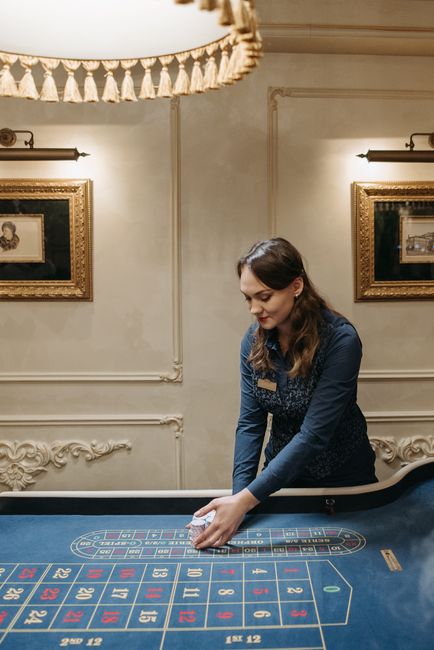
Every casino floor tells the same story in lights and noise: somebody just won big. The slots are screaming, the roulette wheel is spinning, and somewhere a guy in a wrinkled polo shirt is high-fiving a cocktail waitress because he hit a royal flush. What the floor never advertises is the mathematical truth underneath the glitter. The house edge is real, it is persistent, and over enough hands, spins, and deals, it will extract its pound of flesh from almost everyone who sits down.
But here's the thing the cynics get wrong: "the house always wins" is a statement about the casino's total book, not about you as an individual player. Skilled players exist. Advantage players exist. People who treat iGaming as a discipline rather than a dopamine dispenser do, in fact, take money out of the system. The gap between them and everyone else comes down to understanding variance, edge, and the specific mechanics of each game. Let's dig into what separates the two groups.
Forget volatility, RTP marketing claims, and the pretty animations. House edge is the built-in mathematical advantage the casino holds on every bet you place. It's expressed as a percentage, and it compounds over time in the most brutal way imaginable.
Here's a quick comparison across common games:
A 5% edge doesn't sound scary until you run the numbers. Bet $100 a hand for 500 hands at a 5% edge and you've theoretically handed over $2,500 in expected losses. Play a 0.5% blackjack game with the same volume and you're looking at $250. Ten times the survival time, ten times the shot at a real win.
Slot machines are the most profitable product in any casino, land-based or online. They're also the most misunderstood. Players talk about "hot" and "cold" machines as if the reels remember the last spin. They don't. Each spin on a modern RNG-driven slot is independent, and the RTP is baked into millions of spins, not your session.
That said, slots aren't all equal. A few practical points: For a closer look, สล็อตเว็บตรง has helpful details.
The honest advice: play slots because you enjoy them, set a session budget, and never chase. The moment you try to "make back" a loss on a slot, the math has already beaten you.
If you want a real edge, poker is the only mainstream game where skill consistently outweighs luck over a meaningful sample. That's because you're not playing against the house, you're playing against other people, and the house just takes a rake. The rake is the tax, but it's a beatable tax if you're better than your table.
What separates winning poker players from losing ones isn't fancy bluffs. It's discipline and process:
Poker also rewards volume and study almost equally. Twenty hours a week of play with zero study might keep you break-even. Ten hours of play and ten hours of reviewing hands, running equity simulations, and analyzing opponents will put you in profit.
The iGaming industry is built on acquisition and retention, and the bonus is its sharpest weapon. A 100% deposit match with 40x wagering requirements sounds generous until you do the math. Deposit $100, get $100 bonus, and you need to wager $4,000 before you can withdraw anything. At a 3% house edge, your expected loss on that $4,000 is $120. The bonus has negative expected value.
Good bonus value looks like this: low wagering (10x or less), high game weighting (slots at 100%, not 10%), no max-cashout clause that caps your win at $200, and a fair time window. Read the terms. Every single time. The players who profit from bonuses are the ones who treat the terms page as the real offer and the headline number as decoration.
Here's the uncomfortable truth that ties all of this together: the mathematical edge is only half the battle. The other half is behavioral. Casinos are engineered to dismantle discipline. Free drinks, no clocks, no windows, loyalty points, and the constant promise of the next big hit. Online, it's even more insidious because the casino lives in your pocket.
Advantage players build systems against themselves. Hard stop-losses. Session time limits. A separate bankroll account that never touches rent money. Tracking software that logs every session so they can see the truth in numbers rather than trust their memory. It sounds boring. It's also the reason the same small group of people keeps cashing out while everyone else keeps reloading.
The house edge isn't negotiable, but your choice of game, your bet sizing, your discipline, and your willingness to walk away are entirely yours. A player who studies basic strategy, plays tight from position in poker, avoids the worst slot RTPs, and ignores predatory bonuses is playing a completely different game than the casual punter next to them, even if they're sitting at the same table.
iGaming can be genuinely entertaining, and for a small percentage of disciplined players, it can even be profitable. But it only rewards people who treat it like a skill game with entertainment value, rather than a lottery ticket with a light show. Know the numbers. Respect the variance. And never bet money you're not willing to lose. That's not a cliché, it's the entire strategy compressed into one sentence.

Cedar Bramble Simple, genuine and looked after with care — the kind of place worth returning to.

Cedar Bramble No rushing, no fuss — just thoughtful notes and practical help, written by people who care.

Identify wild garlic safely by its pungent leaves and white flowers. Pick responsibly in woodland, avoiding rare plants and protected sites.

Comments
ALina Kelian
19th May 2018 ReplyCedar Bramble An honest, everyday look at the things that make life a little better — with advice you can actually use. ullamco laboris nisi ut aliquip ex ea commodo consequat.
Rlex Kelian
19th May 2018 ReplyCedar Bramble An honest, everyday look at the things that make life a little better — with advice you can actually use. ullamco laboris nisi ut aliquip commodo.
Roboto Alex
21th May 2018 ReplyCedar Bramble No rushing, no fuss — just thoughtful notes and practical help, written by people who care. ullamco laboris nisi ut aliquip ex ea commodo consequat.